The Accelerated Rate of AI Change in Martech
The marketing technology landscape is experiencing a period of unprecedented, rapid iteration driven by artificial intelligence. The rate of change is so dramatic that industry experts compare it to running through an airport to catch a constantly changing gate, by the time the current state of AI technology is documented, the landscape has already shifted.
The industry has quickly evolved from simply using AI to answer questions or generate content to a new reality where autonomous AI agents can execute multi-step tasks on their own.
How Agents are Replacing Traditional Software Solutions
AI agents are rapidly populating every corner of the martech stack, moving well beyond basic chatbots. Today, customer-facing agents provide advanced service resolutions, AI sales development representatives (SDRs) process inbound requests, and internal agents autonomously query CRMs and trigger workflows in marketing automation platforms.
Because these agents can independently orchestrate software tasks, they challenge the traditional need for standalone software solutions.
The boundary between standard SaaS products and AI agents is completely dissolving, industry leaders predict that asymptotically, there will not be a single SaaS product in martech that lacks agent capabilities. Software companies that fail to integrate these capabilities face obsolescence, as businesses will turn to whichever heterogeneous agents best accomplish specific tasks.
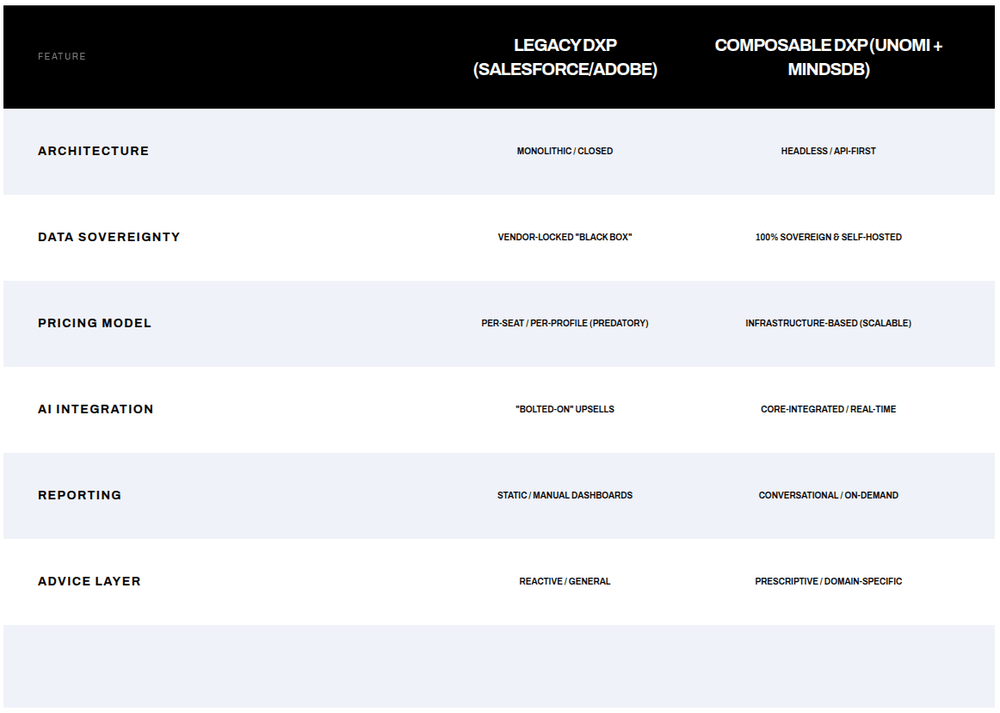
To deliver contextualised digital experiences, businesses traditionally rely on a Digital Experience Platform (DXP) to manage content, delivery, and optimisation across the customer journey. However, as the marketing technology space evolves, organisations are heavily cautioned against adopting closed, proprietary systems. When vendors limit the free movement of data or lock customers into their specific ecosystem, the platform becomes rigid, inflexible, and significantly more expensive in the long term.
To remain competitive and agile, the modern enterprise must steer toward an open DXP architecture, prioritising systems that integrate easily via APIs and consume data in flexible formats.